
AITELONG Products
SAT-OMS Fiber Optic Micro-Monitoring System
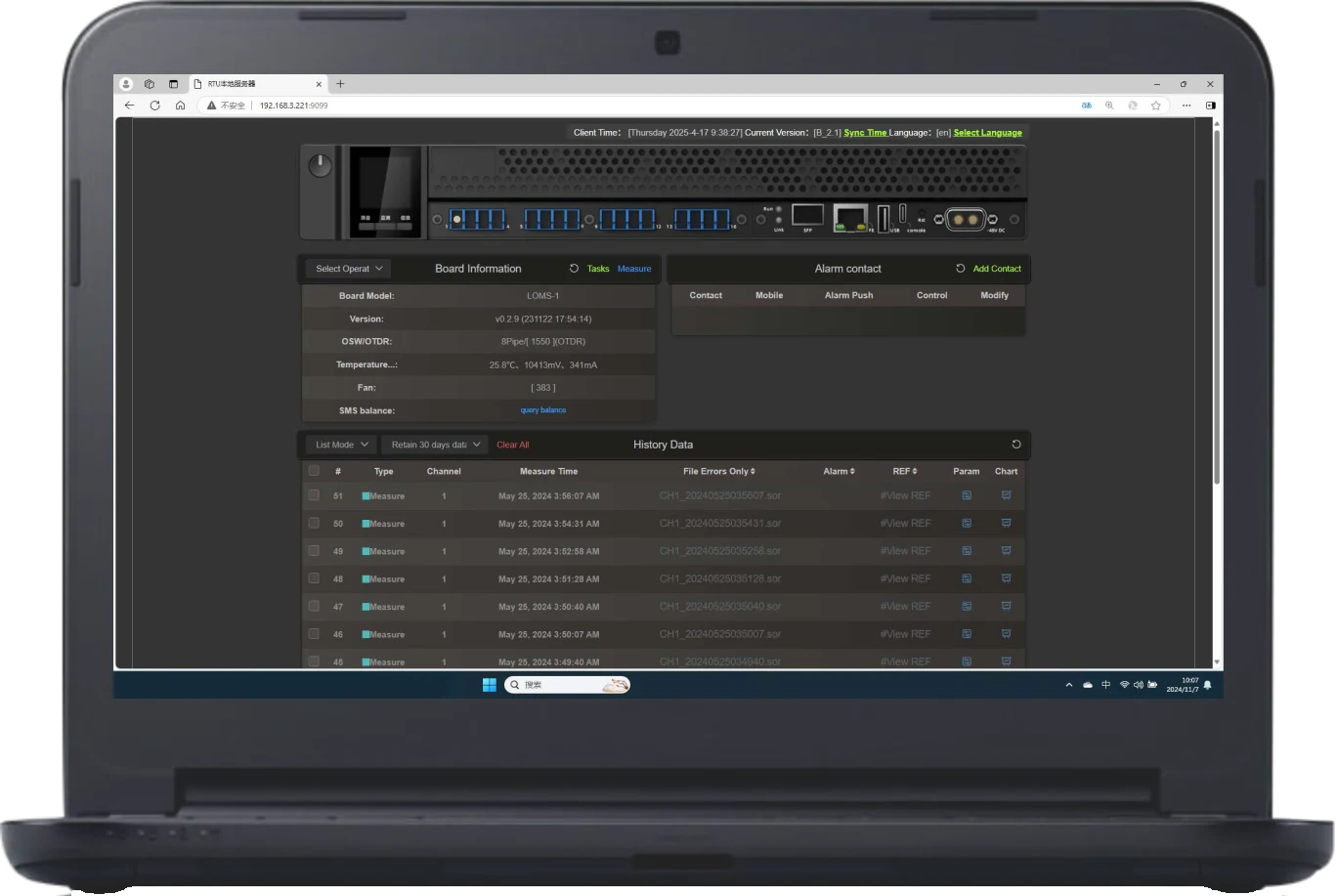

SAT-OMS
SAT-OMS Fiber Optic Micro-Monitoring System
Fiber optic micro-monitoring system, a minimalist design concept has created a brand-new monitoring solution.
Contact Aitelong →A Flexible, Convenient, Low-Cost Option That’s Ready to Use Upon Installation


Fiber optic micro-monitoring system, a minimalist design concept has created a brand-new monitoring solution. It eliminates complicated network management development steps, simplifying the process to just a single network cable connection to start monitoring. The precise calibration between hardware and software makes the entire monitoring process smooth and effortless, allowing both beginners and experienced users to appreciate its convenience and efficiency.
System background
With the continuous development of information technology and intelligence, fiber optic communication has become an important means of information transmission in modern society. Due to its advantages of high transmission speed, large capacity, and strong anti-interference capability, fiber optic cables are increasingly widely used in the field of communication.
1. The Impact of Fiber Optic Cable Failures
Fiber optic cable failures can lead to a decline in cable performance or even interruptions. This not only affects communication quality but may also result in significant economic losses.
2. The Need for Real-Time Monitoring
Real-time monitoring can help promptly detect and locate faults, reduce recovery time, and improve the operational efficiency of communication networks.
3. The Trend of Automation
Automated monitoring systems can enhance the efficiency and accuracy of fiber optic fault handling, ensuring high-quality operation of fiber optic communications.
4. Economic Benefits
Reduce economic losses caused by fiber optic cable failures and improve the reliability of communication services, thereby generating long-term economic benefits
System features
- A more cost-effective monitoring option
1). Plug and play, no deployment required
Unlike the cumbersome deployment process of traditional systems, it only requires a single network cable connected to a computer to start the monitoring task.
2). Standalone, no computer needed
After monitoring begins, the status of the monitoring lines and devices can be viewed on the small screen without a computer.
3). Flexible setup, easy to use
IU height for 19-inch racks or desktop placement. Can be deployed in server rooms or at user sites for monitoring.
- A simpler and more user-friendly monitoring system
Pain points for maintenance personnel in traditional monitoring system
1)Complex system functionality
2). High knowledge barrier.
3). Lack of practical opportunities
The complexity of the traditional
monitoring systems itself makes it difficult for novices to understand the working principle of the entire system and the interaction between various components. They need to master a lot of professional terms and theoretical foundations. It is not possible to become proficient in 1-2 training sessions. A lot of training costs need to be invested, and it is difficult to quickly learn and master through practice. Ultimately, the equipment and system become decorations and can’t play a practical role
LOMS Solution
1) Simple system structure
2). No specialized knowledge required
3). OTDR simulation available
LOMS-1 features a clear single-machine structure, with a simplified interface and operation process that allows beginners to quickly grasp the basics. By learning OTDR operation, users can swiftly engage in tasks and simulate common issues, making it easier to learn problem-solving procedures. This significantly reduces learning costs and maximizes the utility of the equipment and system.
- Faster fiber network repair
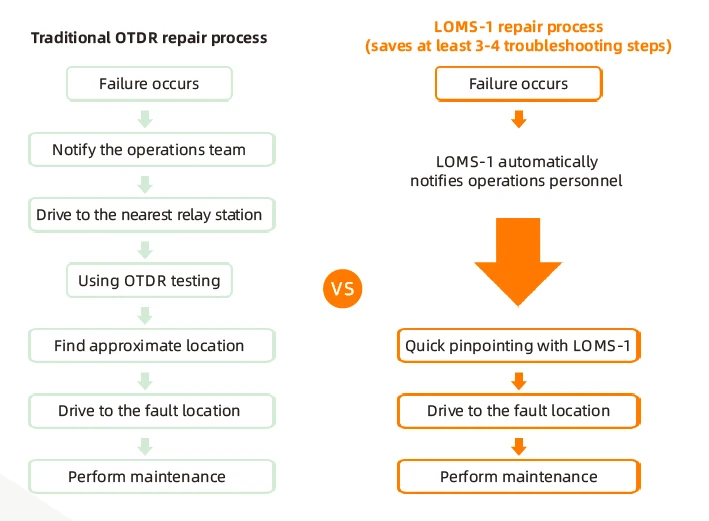
Compared to traditional fiber testing that typically uses OTDRs, detection and repair usually occur only after a fault. This results in slow response times and a lack of effective means for rapid communication restoration.
SAT-OMS provides real-time monitoring of fiber optic networks and automatically tests fibers. It quickly and accurately identifies fault points and causes, reducing downtime and helping maintenance personnel address issues efficiently, thereby lowering repair costs.
Comparison of Traditional OTDR Repair Process and SAT-OMS Repair Process.
High durability: Low power consumption with minimal cooling requirements, enabling long-term operation in complex environments without performance degradation or failures, ensuring infrequent maintenance and replacements for stable long-term performance.
Reduce maintenance costs: SAT-OMS accurately locates fiber optic faults, preventing unnecessary repairs and resource waste.
Operators can use manpower and resources more effectively, lowering costs and improving efficiency.
Occasional attenuation events: may occur in a fiber optic cable in a community. When maintenance personnel arrive, the issue often resolves itself, necessitating 24-hour monitoring to address such faults, which incurs high labor costs. In this case, the SAT-OMS can be temporarily moved to the security room, connected to the fiber interface, and quickly configured for 24-hour monitoring.
System expansion
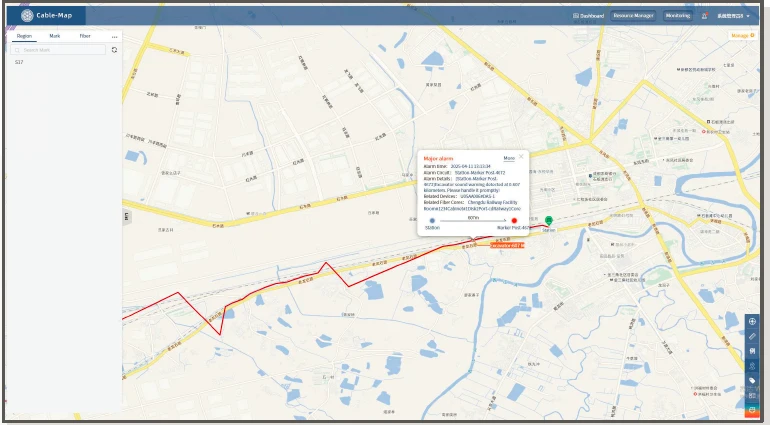
Supports integration with various systems, such as the Cable-Map fiber monitoring resource management system. It utilizes GIS maps for resource management, significantly reducing fault location time in complex environments and during nighttime incidents. For large-core or backbone fiber faults, it allows for precise and quick dispatch of fault locations and information to maintenance personnel, enhancing communication efficiency. Maintenance staff can also directly use their phones to locate faults.
Monitoring Solutions
Single spare fiber patrol monitoring
Occupy a spare fiber core in the user's optical cable, LOMS-1 uses 1550nm wavelength, switch different lines through the optical switch, and performs a patrol test on all monitored optical cables.
1310nm/1550nm
Optical fiber
1310nm/1550nm
1550nm
To the ODF end
1550nm
2024.02.21 19:32 1
1 2 3 4
5 6 7 8
9 10 11 12
13 14 15 16
LOMS-1
Optical transmission device
Optical transmission device
Online Fiber Single-Core Wheel Patrol Monitoring
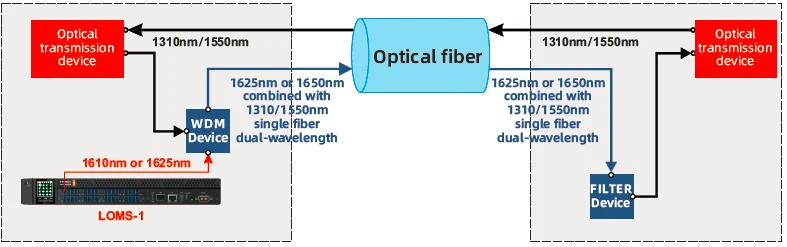 To avoid communication wavelengths (typically 1550 nm or 1310 nm), the SAT-OMS uses 1625nm as the monitoring wavelength for patrol monitoring. At the same time, in order not to affect the normal operation of the communication fiber core, WDM and FILTER are added at both ends of the communication optical cable for wave combining and filtering
Application scenarios
- FTTx network applications
FTTx is a fiber-to-the-x (user, home, enterprise, etc.) network architecture developed to address issues such as insufficient bandwidth and slow transmission rates in traditional copper cable networks. In an FTTx network, fiber optic cables serve as the primary transmission medium, enabling higher bandwidth, faster transmission rates, and more stable connections, thereby meeting users' demands for high-speed broadband and high-quality communication services.
Home broadband line fault detection: The optical cable monitoring system tracks the status of broadband lines in real time, detecting issues like breaks or damage. When a fault occurs, it alerts operators and quickly locates the problem, helping to reduce repair time and enhance service levels.
Optical cable security monitoring in complex environments: In challenging settings like subway tunnels and industrial parks, optical cables are vulnerable to damage or theft. The monitoring system tracks the cables' security status in real time, issuing alerts for any anomalies and quickly locating issues, enabling operators to take prompt action to ensure network safety and stability.
- SAT-OMS FTTx monitoring case in a certain city
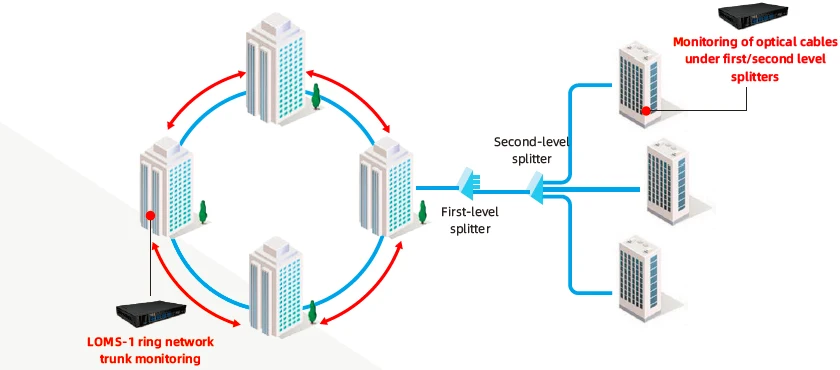
The SAT-OMS's compact design and mobility enable real-time monitoring of urban trunk lines in FTTx networks and sporadic weak signals at splitters. This effectively addresses challenges in locating faults and navigating complex cable topologies, boosting customer satisfaction.
- Data Center Network
The data center is the foundation of cloud computing and big data services. Fiber optic cables connect the data center to users, ensuring continuous and secure data transmission through monitoring.
Enhancing data center reliability and stability: Real-time monitoring of fiber optic cables allows for prompt detection and resolution of faults, ensuring smooth operations and reducing the risk of data transmission interruptions and loss.
Improving maintenance efficiency and reducing costs:Real-time monitoring of fiber optic cable status allows the system to promptly detect faults and provide clues for locating and resolving issues, thereby reducing the workload and maintenance costs for personnel and enhancing the operational efficiency of the data center.
In addition, it also includes railway/high-speed rail monitoring, remote or rural area communications, highway monitoring, military perimeter monitoring and other scenarios.
Optical cable monitoring technology includes OTDR testing, optical fiber sensing technology and real-time monitoring system, which can realize real-time monitoring of optical cable status, timely detection and repair of faults, and improve network reliability and security.
- Urban Communication Network
In the city's communication network, optical cables are the key to connecting various network nodes. Monitoring optical cables can detect and solve faults in a timely manner and reduce the time of network interruption. Such as monitoring networks, transportation networks, life and office networks, etc.
Public safety monitoring: surveillance cameras, alarm systems, emergency call equipment, etc. to improve the safety and security level of the city.
Smart traffic management: Features such as traffic surveillance cameras, traffic light control, traffic flow monitoring, and optimized route planning to improve traffic efficiency and reduce traffic congestion.
Smart energy management: electricity, gas and water resources to optimize and reduce energy consumption and promote sustainable urban development.
Smart life and office: work network, life and entertainment movies/games/videos. Achieve faster network services.
Product Parameters
Monitoring Wavelength | Optional: 1550nm / 1625nm (with filter) / 1650nm (with filter) |
Dynamic Range | 1550nm optional 20/34/40dB, 1625/1650nm optional 32/38dB |
Event Dead | 3/15m |
Monitoring Channel | Maximum 32 channels (time sharing) |
Optical Interface | LC/APC |
Communication Interface | 10/100M network port, SFP optical port (optional) |
Wireless Interface | 4G SMS (optional) |
Main Control Module | 32bit dual core processor |
Power Supply | -48V DC or 220V AC |
Operating Temperature | 0~50℃ |
Storage Temperature | -20~70℃ |